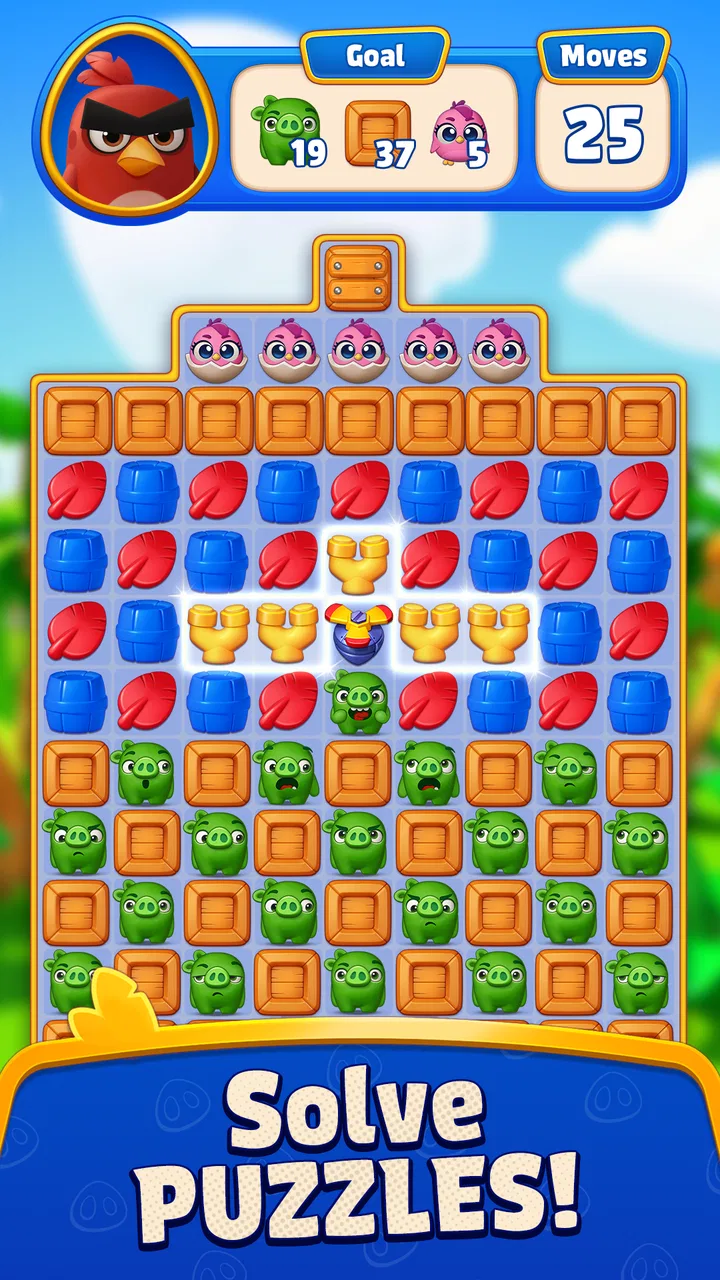
Angry Birds Match
- 4.7
- Rating
- 10.00K
- Installs
- Free
- Price

 Analysis by App-foxy
Angry Birds Match is the kind of casual game I can open for a few minutes without needing to learn a complicated system first. Its basic appeal comes from combining match-three play with the familiar Angry Birds world, so the experience feels immediately approachable rather than like a completely new puzzle language. I found that useful when I wanted something light during a short break, especially because the game is aimed at everyone and does not demand the attention of a long strategy session.
Rovio Entertainment Oy keeps the presentation centered on the flock, while the puzzle format gives the characters a practical role in the play rather than leaving them as decoration. The result is cheerful and accessible, but it also raises an important question: does the game remain worth opening after the first burst of curiosity disappears? My answer is cautiously positive. It has enough low-pressure appeal for regular short sessions, although players who want deep planning, endless novelty, or a completely interruption-free experience may eventually look elsewhere.
What the first week feels like
The first few sessions are easy to understand. You match pieces, look for useful combinations, and progress through the game at a pace that suits casual play. I did not feel that I had to study a manual or memorize a large set of rules before enjoying it. That matters on a phone, where a game often has only a few seconds to prove that it deserves another session.
You May Also Like

 AccuWeather: Weather Radar
AccuWeather Review: A Quick, Clear Forecast for Everyday Decisions
For everyday plans, the best forecast is the one you can understand quickly. AccuWeather makes rain timing, radar, and local conditions easy to act on, with a few trade-offs.

 Hill Climb Racing
Why Hill Climb Racing Still Turns Crashes Into One More Run
A tiny car, a bumpy hill and one more upgrade: Hill Climb Racing keeps resurfacing because its simple chaos makes every near-miss feel personal.

 AliExpress - Shopping App
AliExpress Makes Global Shopping Feel Personal, but Shoppers Bear the Risk
AliExpress turns a global marketplace into a pocket-sized discovery engine. Its reach is useful, its shopping loop compelling, and its trade-offs easy to miss.

 Lords Mobile: Kingdom Wars
Lords Mobile Is a Kingdom-Building Routine, Not a Quick Match
A case-by-case verdict on the building, battles, device demands, and social commitments that make Lords Mobile rewarding for some players and exhausting for others.

 PDF Scanner app - TapScanner
TapScanner Makes Paperwork Easier to Capture, Check, and Share
TapScanner makes scanning with a phone feel less like a rescue operation and more like a dependable step in getting work done. Its capture tools are useful, though not flawless.

 Block Blast!
 Shows How Much a Puzzle Game Can Leave Out
A quiet grid game shows why puzzle players increasingly value instant clarity, repeatable skill and low-pressure play—and where the genre still needs to catch up.
More From Our News Desk
View All News


The Angry Birds setting gives the familiar puzzle format extra personality. Instead of feeling like an anonymous grid, the game has a recognizable tone and a playful identity. That difference is small mechanically, but it affects how willing I am to return. A plain match-three game can be perfectly functional, yet the flock makes this one feel more inviting when I am choosing between several similar downloads.
During the first week, I would use it in short bursts: while waiting for an appointment, after finishing a task, or when I wanted a gentle distraction before bed. It fits those moments better than a game that requires a long uninterrupted run. The casual category is a good match for that role, because the experience is built around quick decisions rather than a demanding competitive routine.
One useful habit is to avoid treating every move as an emergency. I found it more satisfying to pause briefly and scan the board for a larger opportunity instead of immediately taking the first obvious match. That small change makes the game feel less like random tapping and more like a light puzzle. It also helps preserve the sense of control that keeps a match-three game from becoming repetitive too quickly.
The free entry point makes trying it uncomplicated. There is no purchase required to see whether the style suits you, while optional in-app items range from $0.99 to $99.99 per item. That wide range is worth keeping in mind from the beginning. I would approach the game as a free casual pastime, not as something where spending should be part of the normal routine.
The early appeal is strongest for three kinds of players. First, it suits someone who already enjoys match-three games but wants a more character-driven presentation. Second, it works for Angry Birds fans who prefer a slower puzzle format to action-focused play. Third, it is a reasonable choice for a family-friendly mobile game because its content rating is Everyone.
It is less convincing for somebody searching for a complex puzzle challenge immediately. The early learning curve is friendly, which is a strength for accessibility but a weakness if you want intricate systems from the first launch. I also would not choose it as my main game for long travel sessions unless I already knew that its progression held my attention, because the simple foundation can feel familiar very quickly.
Small decisions that improve casual play
My most practical tip is to play with a clear session limit. Match-three games are easy to extend one round at a time, and that can turn a short break into a longer distraction without feeling intentional. Deciding in advance to play only until a natural stopping point helps the game stay useful rather than becoming background noise.
I also recommend separating “I want to relax” sessions from “I want to make progress” sessions. When relaxing, I would take the straightforward move and enjoy the presentation. When trying to play well, I would slow down, check the whole board, and prioritize moves that create more possibilities. This distinction gives the same basic mechanics two different uses and makes the experience feel less one-dimensional.
Another overlooked advantage is its suitability for interrupted attention. If a message, conversation, or household task pulls me away, a casual puzzle is easier to put down than a game built around real-time pressure. That makes it a better companion for ordinary daily routines than many more ambitious mobile titles.
Whether it still earns attention after the novelty
The first-month question is different from the first-week question. At the beginning, the Angry Birds identity does much of the work. Later, the puzzle loop has to carry the experience by itself. I think it can do that for players who genuinely enjoy matching games, but the lasting value depends on how much satisfaction they get from small improvements rather than dramatic changes.
For me, the strongest recurring value is convenience. I can return without rebuilding a complicated mental context, and the game remains suitable for a short session. That is not a minor benefit. Many mobile games ask for regular commitment, while this one can occupy the space between larger activities. If your ideal game is something you can play casually without making it the center of your day, that consistency is meaningful.
The weaker side is variety. The central interaction remains a match-three activity, so players who need a constant stream of new mechanics may feel the formula settle into a routine. The Angry Birds presentation helps soften that repetition, but it cannot completely remove it. Once the initial excitement fades, I judge the game less by its theme and more by whether each session still gives me a satisfying reason to make the next move.
Compared with a typical match-three alternative, this game’s clearest distinction is its flock-based personality. A generic competitor may feel cleaner or more focused if all you want is efficient puzzle solving. Angry Birds Match is preferable when the characters and tone matter to you. That is a genuine trade-off: the setting adds warmth and familiarity, but it does not automatically create deeper strategy.
Compared with the usual Angry Birds games, this is a calmer option. Someone expecting the direct physical comedy and action of launching birds may find the format surprisingly different. I would recommend it to fans who are open to a puzzle interpretation of the brand, not to someone who wants the exact rhythm of the classic slingshot experience.
Its average rating of 4.8 from around 1.3 thousand ratings suggests that early users have responded warmly, and the game has passed over 10 thousand installs. Those figures make it look promising without proving that it will become a permanent favorite for every player. In my view, the more useful test is whether you enjoy returning when the novelty of the characters is no longer doing all the work.
A realistic month-to-month routine
Imagine opening the game during a commute or while waiting for a friend. You have only a few minutes, so you play a small amount, stop when your attention is needed elsewhere, and return another day. That is where the game makes the most sense over time. It supports a repeatable habit without requiring a fixed daily schedule, which is more sustainable for me than a title that makes every missed session feel costly.
For a child or younger player, I would treat it as a shared or supervised entertainment choice rather than an unattended spending environment. The Everyone rating makes the content broadly accessible, but the presence of optional purchases still means device-level purchase controls are sensible. That is not a criticism of the puzzle itself; it is simply good practice for any free game with paid items.
For an adult who wants a quiet mental reset, the game can work well between demanding tasks. I like that the matching format gives my attention something specific to do without asking me to absorb a large story or complicated control scheme. On the other hand, if you use games to sharpen advanced planning skills, you may find a dedicated logic or strategy title more rewarding in the long run.
The current version is 0.14.1, and I would keep the app updated through the normal store process so the installed build remains current. I would not make an update routine the reason to play, though. A healthy long-term relationship with a casual game should come from enjoying its sessions, not from feeling obligated to check it simply because it is there.
How much maintenance the game demands
Maintenance is not only about storage or updates; it is also about attention. This game has a low mental setup cost, which is one of its best qualities. I can return after a gap and understand what I am doing quickly. That makes it easier to keep installed than a game whose systems become confusing when I stop playing for a while.
The potential burden comes from the temptation to turn casual play into a routine that needs constant checking. If you prefer games that can be finished and put away, a progression-based match-three experience may feel less satisfying than a self-contained puzzle collection. I would keep this installed only if I actually enjoy the recurring loop, not because the free download makes it harmless to accumulate indefinitely.
There is also a financial maintenance question. The free price is helpful for experimentation, but optional purchases can change the way a player approaches difficulty or progress. My advice is to decide before playing whether spending is completely off the table or whether you have a firm personal limit. Without that decision, small purchases can become part of the habit rather than an occasional choice.
I would also consider the game’s place on a shared device. Because it is rated Everyone, it may be attractive to several people in a household, but that can blur who is playing and who is making purchase decisions. Separate profiles or purchase restrictions are practical safeguards. They let the game remain a harmless shared distraction without turning a casual session into an unwanted billing surprise.
For storage and battery expectations, I would judge it by your own phone rather than assume every device behaves the same way. The important practical point is that it is a mobile-first casual game, so its value comes from being available when you have a spare moment. If your phone is already crowded with games you rarely open, installing another one only makes sense if the Angry Birds presentation gives you a reason to remove something else.
Where fatigue begins
The biggest source of fatigue is the basic one: matching games can become predictable. Even when individual boards require attention, the broader gesture of matching pieces is familiar. I noticed that the game is most enjoyable when I approach it as a short activity with a clear mood, not as a title that must provide endless surprise every time I open it.
Theme fatigue is possible too. The flock is a strong introduction, but familiar characters eventually become part of the background. If your interest in Angry Birds is limited to recognition, the setting may not be enough to sustain you. Players who love the characters, however, will probably get more mileage from the presentation than someone who sees it as a decorative layer over a standard puzzle.
Monetization can create another kind of tiredness, even when I do not buy anything. The presence of items priced from $0.99 to $99.99 means I would pay attention to how often the game invites spending and whether those prompts interrupt the relaxed rhythm. I would skip the game if I knew that visible purchase options made free play feel constantly restricted or pressured.
There is also a mismatch between the game’s friendly surface and some players’ expectations. “Casual” does not mean every person will find it effortless or endlessly soothing. A player who wants a completely passive experience may still find matching requires more concentration than expected, while a competitive player may find it too gentle. The right audience is someone who enjoys light decisions and a playful setting without demanding a serious challenge.
When fatigue appears, I would not immediately uninstall it. I would first change the way I use it: shorter sessions, less concern about perfect play, and longer gaps between visits. If that does not restore interest, the honest conclusion is that the game has served its purpose. A casual title does not need to remain installed forever to have been worthwhile.
My long-term verdict
After the first-week charm fades, Angry Birds Match earns its place mainly through accessibility and convenience. I like it as a friendly match-three game that fits into small gaps, and I think the Angry Birds identity gives it more personality than an interchangeable puzzle app. The experience is especially suitable for players who want something family-friendly, easy to resume, and pleasant in short sessions.
I would recommend it to an Angry Birds fan who is happy to try a calmer puzzle format, to a casual player who wants a recognizable theme, and to anyone who values low-commitment mobile entertainment. I would also mention the free starting point, while being clear that optional purchases mean sensible spending boundaries are worthwhile from the beginning.
I would skip it if you are looking for deep strategy, a finite puzzle campaign, action-heavy bird launching, or a game that feels radically different from other match-three options. A competing puzzle title may be better if you care more about mechanical complexity than character presentation. A premium, self-contained game may suit you better if you dislike recurring purchase prompts or open-ended progression.
My final judgment is that it deserves a place on a phone when its specific strengths match your routine. It is not a game I would insist everyone keep forever, but it has a useful role as a light, approachable break game. The lasting value comes from fitting naturally into your day, not from pretending the match-three formula never becomes familiar. If that kind of repeatable simplicity sounds appealing, this free casual release from Rovio Entertainment Oy is worth trying.
FAQs for Angry Birds Match
01What is Angry Birds Match?
Angry Birds Match is a free-to-play match-3 puzzle game based on the popular Angry Birds universe. You complete levels by matching three or more identical items, then use the rewards to help the birds rescue hatchlings and unlock new areas. The game combines familiar puzzle mechanics with character collection, events, costumes, and light adventure elements.
02Is Angry Birds Match free to download and play?
Yes, Angry Birds Match can generally be downloaded and played for free on supported Android and iOS devices. However, it includes optional in-app purchases for items such as boosters, extra lives, or other helpful resources. Progress is possible without spending money, although later levels and limited-time challenges may encourage careful use of moves or optional purchases.
03Does Angry Birds Match require an internet connection?
An internet connection is recommended for the best Angry Birds Match experience because online access may be needed for advertisements, special events, updates, cloud-related features, and in-app purchases. Some puzzle content may remain playable offline, but availability can vary by device and game version. Connecting regularly also helps ensure that progress and event information are updated correctly.
04Is Angry Birds Match suitable for children?
Angry Birds Match is colorful, easy to understand, and generally suitable for a broad audience, including children who enjoy casual puzzle games. Nevertheless, parents should review the game’s in-app purchase settings and advertising options before allowing younger players to use it. The game may also include social or online features, so parental controls and device restrictions are worth checking.
05What are the main advantages and disadvantages of Angry Birds Match?
The main advantages are its cheerful presentation, familiar Angry Birds characters, simple controls, varied match-3 challenges, and entertaining reward system. It is approachable for beginners but can still become demanding in advanced stages. On the downside, lives and limited moves can slow progress, advertisements may appear, and optional purchases or event mechanics may feel more noticeable as you continue playing.
Pros
- Fun match-3 gameplay with familiar Angry Birds characters.
- Short levels make it easy to play during quick breaks.
- Colorful graphics and lively animations look great on mobile.
- New outfits and bird characters add variety to progression.
- Playable offline
- making it useful when you have no connection.
Cons
- Lives and boosters can limit longer play sessions.
- Difficulty spikes may require repeated attempts on some levels.
- Progression can feel repetitive after extended play.
- In-app purchases may be tempting when resources run low.
- The game requires considerable storage and may drain battery.

Angry Birds Match
Gallery